
Golf Cart vs. LSV in Florida: Insurance and Registration
Quick answer: In Florida, a golf cart can't go faster than 20 mph, doesn't need to be registered or insured under state law, and may be driven only on roads designated for golf carts. A low-speed vehicle (LSV) has a top speed above 20 and up to 25 mph, may use roads posted 35 mph or less, and must be titled, registered and insured with at least $10,000 in Personal Injury Protection (PIP) and $10,000 in Property Damage Liability (PDL).
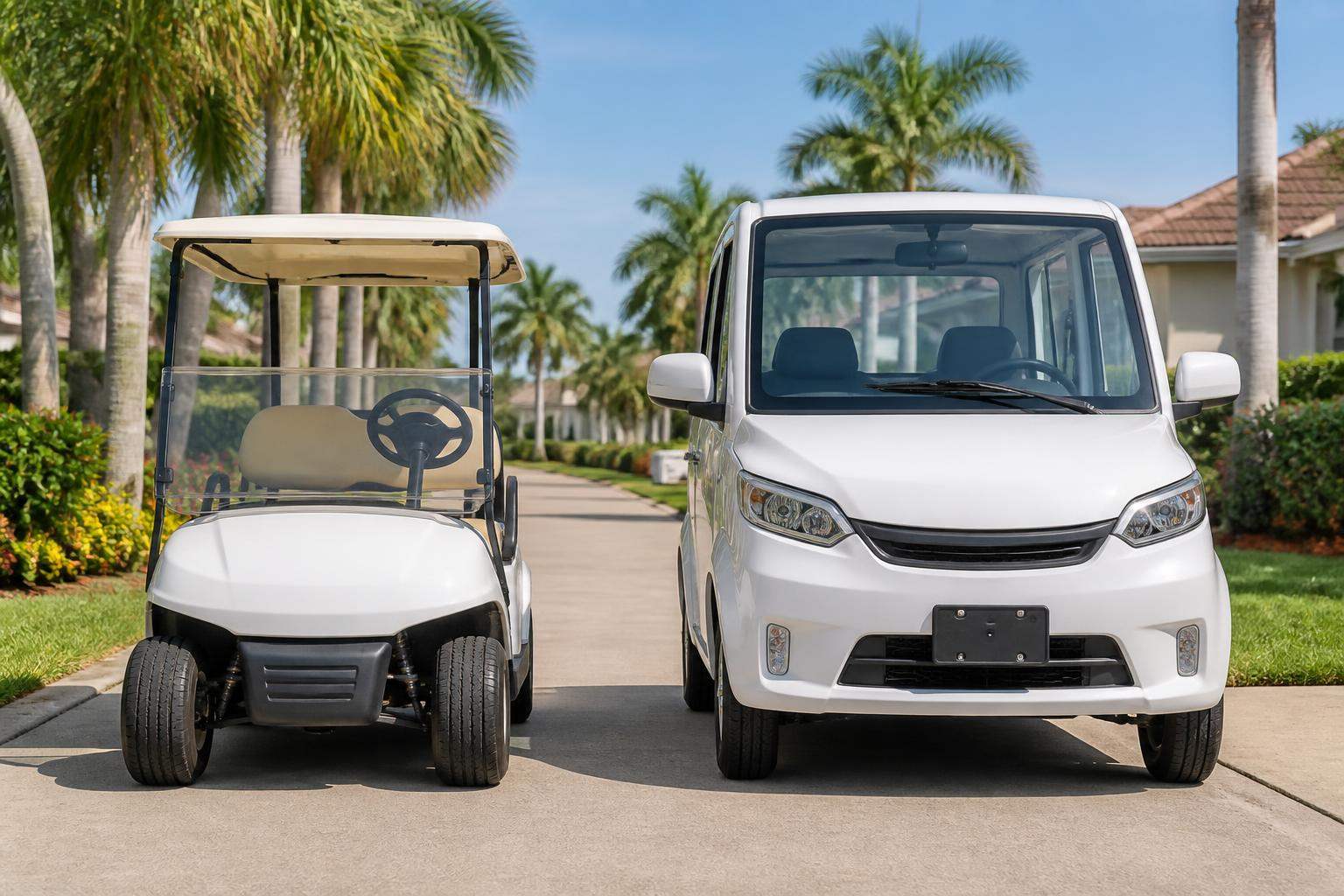
A golf cart and a low-speed vehicle (LSV) can look almost identical, but Florida law puts them in two different categories. The category decides where the vehicle may be driven, who may drive it, and whether it has to be titled, registered and insured. The rules below come from the Florida Statutes and the Florida Department of Highway Safety and Motor Vehicles (FLHSMV).
The legal definitions
Both definitions are in section 320.01, Florida Statutes.
Golf cart, section 320.01(22): "a motor vehicle that is designed and manufactured for operation on a golf course for sporting or recreational purposes and that is not capable of exceeding speeds of 20 miles per hour."
Low-speed vehicle, section 320.01(41): "any four-wheeled vehicle whose top speed is greater than 20 miles per hour but not greater than 25 miles per hour, including, but not limited to, neighborhood electric vehicles."
Golf carts: where and how they may be driven
Section 316.212, Florida Statutes, opens by stating that the operation of a golf cart upon the public roads or streets of the state is prohibited except as the section provides. The main rules are:
Designated roads. A golf cart may be operated only upon a county road or municipal street that the county or municipality has designated for use by golf carts, along with certain other designated roads listed in section 316.212(1).
Speed limit of the road. FLHSMV states that golf carts may be operated on roadways that are designated for golf carts with a posted speed limit of 30 mph or less.
Hours. Under section 316.212(5), a golf cart may be operated only between sunrise and sunset, unless the responsible governmental entity has determined it may be operated between sunset and sunrise and the cart is equipped with headlights, brake lights, turn signals and a windshield.
Equipment. Section 316.212(6) requires efficient brakes, reliable steering apparatus, safe tires, a rearview mirror, and red reflectorized warning devices in both the front and rear.
Driver. Under section 316.212(7), a person under 18 may not operate a golf cart on public roads or streets without a valid learner's driver license or valid driver license. A person 18 or older must have a valid form of government-issued photographic identification.
Section 316.212(8) also allows a local government to adopt a more restrictive ordinance on golf cart operation and equipment that applies to unlicensed drivers, so check the rules for your city or county.
Golf carts: registration and insurance
Section 320.105, Florida Statutes, says that golf carts, as defined in section 320.01, when operated in accordance with section 316.212, are exempt from the provisions of chapter 320 that require the registration of vehicles or the display of license plates.
Section 316.212 does not contain an insurance requirement like the one section 316.2122 sets for low-speed vehicles. Whether an accident involving your golf cart is covered depends on the policies you have, so check your own policy or ask your agent.
Low-speed vehicles: registration, title and insurance are required
Section 316.2122(1), Florida Statutes, authorizes LSVs on the road with these restrictions:
Roads, section 316.2122(1)(a): an LSV "may be operated only on streets where the posted speed limit is 35 miles per hour or less."
Equipment, section 316.2122(1)(b): an LSV "must be equipped with headlamps, stop lamps, turn signal lamps, taillamps, reflex reflectors, parking brakes, rearview mirrors, windshields, seat belts, and vehicle identification numbers."
Registration, insurance and title, section 316.2122(1)(c): an LSV "must be registered and insured in accordance with s. 320.02 and titled pursuant to chapter 319."
Driver, section 316.2122(1)(d): any person operating an LSV "must have in his or her possession a valid driver license."
Under section 316.2122(3), a county or municipality may prohibit LSVs on any road under its jurisdiction if its governing body determines the prohibition is necessary in the interest of safety.
FLHSMV puts the insurance requirement this way: LSVs must be registered, titled and insured with personal injury protection (PIP) and property damage liability (PDL) insurance. To title and register an LSV, FLHSMV lists the Manufacturer's Certificate of Origin, Form HSMV 82040 (Application for Title), and proof of Florida insurance with a minimum of $10,000 PDL and $10,000 PIP.
FLHSMV's Florida Insurance Requirements page adds that the policy must be purchased from an insurance carrier licensed to do business in Florida and that coverage must be continuous even if the vehicle is not being driven or is inoperable.
The requirement is still in force in 2026. Section 627.733 of the 2026 Florida Statutes says every owner or registrant of a motor vehicle required to be registered and licensed in the state "shall maintain security as required by subsection (3) in effect continuously throughout the registration or licensing period," and FLHSMV lists $10,000 in PIP and $10,000 in PDL as the minimum for an LSV.
Converting a golf cart to an LSV
FLHSMV states that golf carts can be converted to LSVs and points owners to the LSV safety equipment requirements. Before titling and registering a converted golf cart, the applicant must present four photographs of the vehicle (front, back and both sides) to a Motorist Services Regional Office for an inspection, VIN assignment, title and registration, along with documents and fees that include:
Form HSMV 84490 (Statement of Builder)
Form HSMV 86064 (Affidavit for Golf Cart Modified to a Low Speed Vehicle)
Form HSMV 82040 (Application for Title)
Original bills of sale or receipts for all parts used in the conversion
A certified weight slip for the converted golf cart
Proof of Florida insurance (minimum $10,000 PDL and $10,000 PIP)
Driving a cart or LSV in The Villages? See our page on golf cart insurance in The Villages, FL. Anywhere else in Florida, see golf cart and LSV insurance.
This article is general information, not legal advice. Statutes change and local ordinances differ, so confirm the current rules with FLHSMV and your local government. To talk about coverage for either type of vehicle, The Ritz Agency in Ocala has more information on our golf cart insurance page.