
Florida Roof Age, 4-Point and Wind Mitigation Inspections
Quick answer: A Florida insurer can't refuse to issue or renew a home policy solely because the roof is less than 15 years old. For an older roof, you can have it inspected, and if the inspection shows at least 5 years of useful life left, roof age alone can't be the reason. A four-point inspection checks the roof, electrical, plumbing and heating, ventilation and air conditioning (HVAC), while a wind mitigation inspection documents features that help your home resist wind.
Three items come up often when a Florida home is insured: the age of the roof, the four-point inspection and the wind mitigation inspection. Each one answers a different question about the house.
How Florida law treats roof age
Section 627.7011(5), Florida Statutes, sets rules for how insurers may use the age of a roof on a homeowner's policy:
- An insurer may not refuse to issue or refuse to renew a homeowner's policy insuring a residential structure with a roof that is less than 15 years old solely because of the age of the roof.
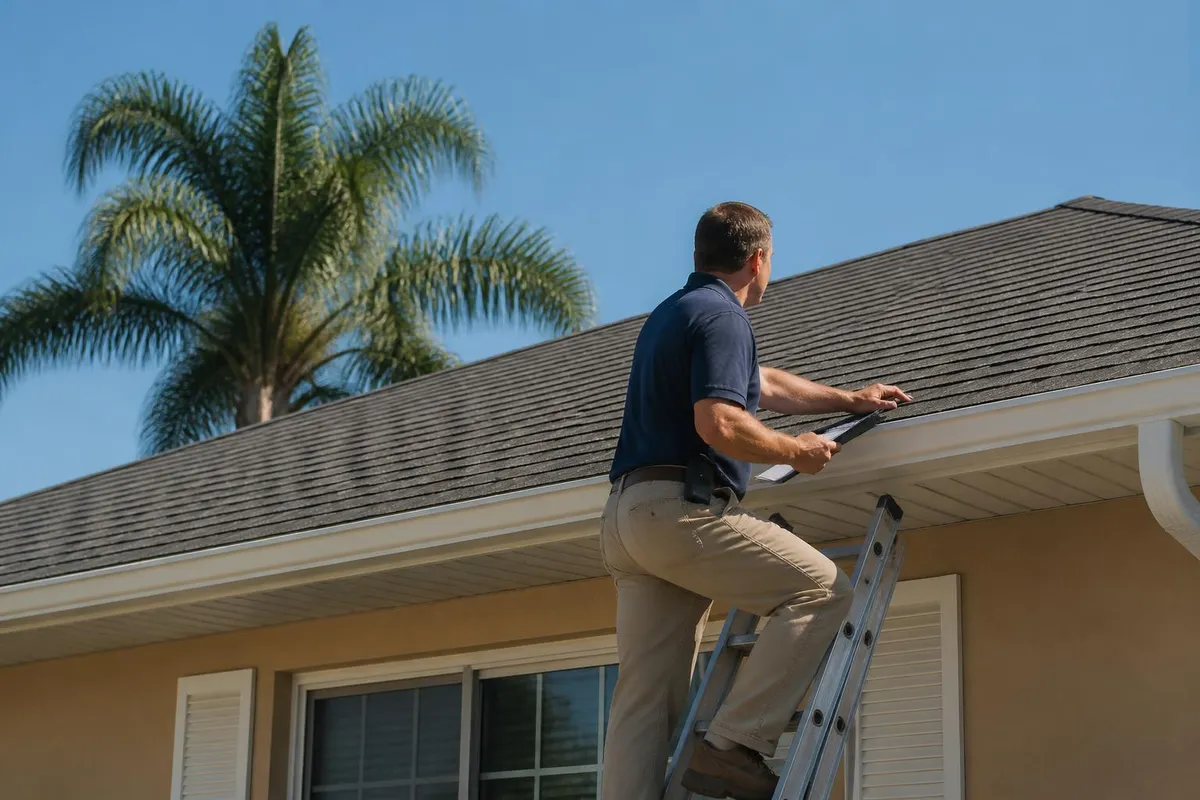
- For a roof that is at least 15 years old, the insurer must allow the homeowner to have a roof inspection performed by an authorized inspector, at the homeowner's expense, before requiring the roof to be replaced as a condition of issuing or renewing the policy.
- The insurer may not refuse to issue or renew solely because of roof age if that inspection indicates the roof has 5 years or more of useful life remaining.
The statute also says how to count the years. A roof's age is calculated from the last date on which 100 percent of the roof's surface area was built or replaced in accordance with the building code in effect at that time. If the roof was replaced in stages, the starting point is the initial date of the partial replacement once later work brought the total to 100 percent.
An "authorized inspector" under this section must be approved by the insurer. The statute's list includes licensed home inspectors, contractors, professional engineers and architects.
Keep the paperwork that shows when your roof was last fully replaced, because that date is what the calculation turns on.
What a four-point inspection covers
Florida's Office of the Insurance Consumer Advocate, part of the Department of Financial Services (DFS), describes a four-point inspection as a specialized evaluation of a property commonly required by homeowners insurance companies in Florida when issuing or renewing a policy. Its primary purpose is to assess the condition and safety of four systems to determine a property's insurability:
- Roofing: the roof's type, age, condition and any visible signs of damage or deterioration.
- Electrical: the type of wiring, the condition of the electric panel and any safety hazards such as exposed wiring or outdated components.
- Plumbing: the water heater and its age, the type of pipes, leaks or other issues, and whether the plumbing has been updated or re-piped.
- HVAC: the age and condition of the heating, ventilation and air conditioning system, its operational status and any visible damage.
The same guide makes several practical points:
- A four-point inspection is not a comprehensive home inspection. It is limited to these four systems.
- It must be completed and signed by a verifiable Florida-licensed professional, such as a general, residential or building contractor, or a home inspector.
- The report generally must be dated within the 30 days before the insurance application is submitted, but each insurance company sets its own acceptable timeframe.
- Depending on the findings, a homeowner may need to complete repairs before an insurance company will issue a policy.
DFS also notes that when an insurer requires this kind of inspection on an older home, the insured or applicant pays for it.
What a wind mitigation inspection documents
A wind mitigation inspection is recorded on a state form. Section 627.711(2)(a), Florida Statutes, directs the Financial Services Commission to develop a uniform mitigation verification inspection form that all insurers must use when policyholders submit it. The Office of Insurance Regulation identifies the form as the Uniform Mitigation Verification Inspection Form, OIR-B1-1802, and says an authorized inspector completes it during the wind mitigation inspection.
Florida's rate filing law, section 627.0629(1), Florida Statutes, refers to fixtures or construction techniques that enhance wind uplift prevention, roof strength, roof covering performance, roof-to-wall strength, wall-to-floor-to-foundation strength, opening protection, and window, door and skylight strength. The Office of Insurance Regulation lists section 627.0629 as the statute behind the inspection form, and updated the form effective April 1, 2026 after the review that section requires. The inspector records what the home has, and your insurer uses the completed form.
Key facts from the state agencies:
- DFS reports that a new version of the form, OIR-B1-1802 (Rev. 04/26), must be used for all inspections as of April 1, 2026.
- The Office of Insurance Regulation says the form is valid for up to five years, provided no material changes are made to the structure and no inaccuracies are found on the form.
- DFS lists who may perform the inspection, including a licensed home inspector, a building code inspector, a general, building or residential contractor, a professional engineer and a professional architect.
- DFS describes this inspection as one a policyholder may elect to have, and says the consumer normally pays for it.
- Under section 627.711, an insurer may require, at its own expense, that a submitted form be independently verified.
Getting ready for an inspection
- Ask your agent or insurer which inspection is needed and how recent the report must be.
- Gather roof records that show the date the roof was fully replaced.
- Verify the inspector's or contractor's license. The DFS guide points consumers to the Florida Department of Business and Professional Regulation for license verification.
This article is general information, not legal advice, and inspection requirements vary by insurer and by policy. For help understanding which reports apply to your home, The Ritz Agency in Ocala explains more on our home insurance page.
Sources
- Florida Statutes, section 627.7011, Homeowners' policies; offer of replacement cost coverage and law and ordinance coverage (Online Sunshine) - http://www.leg.state.fl.us/statutes/index.cfm?App_mode=Display_Statute&URL=0600-0699/0627/Sections/0627.7011.html
- Florida Statutes, section 627.711 (Online Sunshine) - http://www.leg.state.fl.us/statutes/index.cfm?App_mode=Display_Statute&URL=0600-0699/0627/Sections/0627.711.html
- Florida Statutes, section 627.0629, Residential property insurance; rate filings (Online Sunshine) - http://www.leg.state.fl.us/statutes/index.cfm?App_mode=Display_Statute&URL=0600-0699/0627/Sections/0627.0629.html
- Florida Department of Financial Services, Office of the Insurance Consumer Advocate: What to Expect: Four-Point Inspection (PDF) - https://myfloridacfo.com/docs-sf/insurance-consumer-advocate-libraries/ica-documents/four-point-inspection-guide.pdf
- Florida Department of Financial Services: Homeowners Insurance Overview - https://www.myfloridacfo.com/division/consumers/understanding-insurance/homeownersinsuranceoverview
- Florida Department of Financial Services: Mitigation Notices, Inspections and Forms - https://www.myfloridacfo.com/division/consumers/storm/mitigation-notices-inspections-and-forms
- Florida Office of Insurance Regulation: Wind Mitigation Resources - https://floir.gov/consumers/wind-mitigation-resources